Take Caution Before Hand Feeding
Hand feeding an Indian Ringneck is sometimes necessary when a mother will not care for her babies properly. Hand feeding a baby ringneck, or any parrot for that matter, takes patience and is a long commitment. The baby ringneck needs to be fed continually every two hours and this means through the night too. Before you decide to take on such a task, make sure you are ready for this and please research the topic as accidents can easily happen unintentionally.
If you believe hand feeding a day old chick is too difficult, or you believe it’s too time consuming, seek a veterinarian who will take on the task. Most experienced parrot breeders will gladly help in such a situation too.
If you are an established breeder, fostering might be an ideal situation–female ringnecks can care for a newborn chick better then any human can. Along with this superior care, special nutrients are transferred to the chick and this helps to develop its immune system and digestive tract. With that being said, if you must hand feed from day one then begin the hand feeding process.
Things To Know Before Hand Feeding
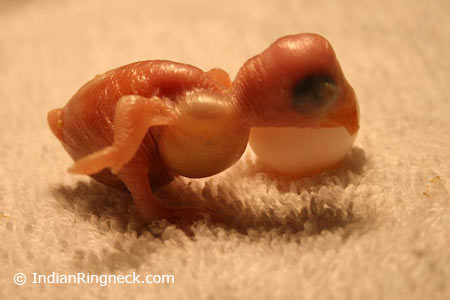
Hand feeding a baby Indian Ringneck from day one is a tedious task. The newborn chick, which is small and wiggly, can be difficult to work with and can easily get cold in a matter of minutes. Their small frame makes them difficult to pick up and makes them extremely fragile. When handling, always disinfect your hands and always make sure to handle the baby ringneck gently.
If the chick was hatched from an incubator do not feed it until six hours after hatching. Feeding the chick too early can kill it.
If the baby ringneck is taken from its parents place the chick inside a brooder and let it warm up. The brooder should be around 95 degrees ferinheight. Though some breeders keep the temperature around 97-98 degrees, I find 95 degrees keeps the chick comfortable enough and stable. If the chick is panting, remove him from the brooder to cool down and decrease the degree by 1 until the chick stops panting.
Once the baby ringneck has been warmed, the first feeding can begin. For any reason at all if food is in the crop from it parents, let this get digested before you feed it. You will see a clear milky liquid in the crop if food is present.
Though it would be ideal to have a plastic pipette, or a syringe specially for hand feeding, an eye dropper will work until a pipette or syringe can be purchased. An eye dropper is small enough to complete the job and will work; however, a syringe will need to be purchased as the chick’s gets bigger.
Tips for hand feeding day old chicks
• Feed formula between 105F-108F.
• For 1st feeding, use only an electrolyte solution.
• Wash all feeding utensils.
• Keep the baby warm. If it gets too cold this could stop digestion.
• Change the paper towels after every feeding.
• If an emergency arises call an avian vet immediately.
• Never force the chick to eat if it does not want more.
• Do not over fill the corp.
• During the 1st few feedings a couple of drops will suffice.
• Feed every two hours, or until the crop is almost empty.
The First Feeding

The first feeding of the chick should be with an electrolyte solution that is unflavored, such as Pedialyte. This electrolyte solution should be given to the chick for the first feeding; this ensures the chick’s digestion tract is working correctly. If the crop empties, it’s time to feed a commercial hand feeding formula.
To do this, gently place a drop of the electrolyte solution on the LEFT side of the baby ringneck’s mouth. Most baby ringnecks will gladly accept the food. If you find the baby is not taking in any of the liquid, place him back inside the brooder and wait fifteen minutes before you try again. Some babies need to practice this before they understand eating from a pipette or syringe. If the baby ringneck will still not accept food, make sure the food is warm enough. Having a hot glass of water next to you would be ideal as holding the pipette in it for a few seconds will warm it up. Make sure to test it on your wrist to ensure it is not scolding hot.
Commercial Hand Feeding Formula
I personally recommend Kaytee’s Exact. I have never lost a bird using this formula and it’s probably, in opinion, the best out there. According to Kaytee’s Exact feeding formula it “contains probiotics to encourage a healthy population on intestinal microorganisms. Also, digestive enzymes (amylase and protease) are included to insure adequate digestion of carbohydrates and proteins.”
It’s obvious this formula was designed for feeding hatchlings to adults. To be sure the baby ringnecks don’t dehydrate I like to substitute the electrolyte solution instead of water for the first five days when using Exact hand feeding formula. If you don’t want to use an electrolyte solution always use the chart shown on the box for mixing the formula. According to Exact, it’s 1 part formula, 6 parts water for a chick that’s 2 days and younger.
The first two days of feeding with the formula will be thin and watery. As the chick grows older increase the thickness and the feedings. It’s important to watch the crop of the chick. Make sure the chick is making healthy droppings and is taking its food regularly. To give you a better example of this process click the link for an online video by Kaytee.
Another great site for hand feeding day old chicks is an article by Linda. Linda is a lovebird enthusiast and goes into detail about hand feeding a day old lovebird chick. Click Here to go there.